
The forecast answers the only cost question anybody outside the commercial team asks: what is this job going to finish at?
This topic includes:
Forecast a budget line
Open the forecast and set, line by line, how that line is expected to finish.
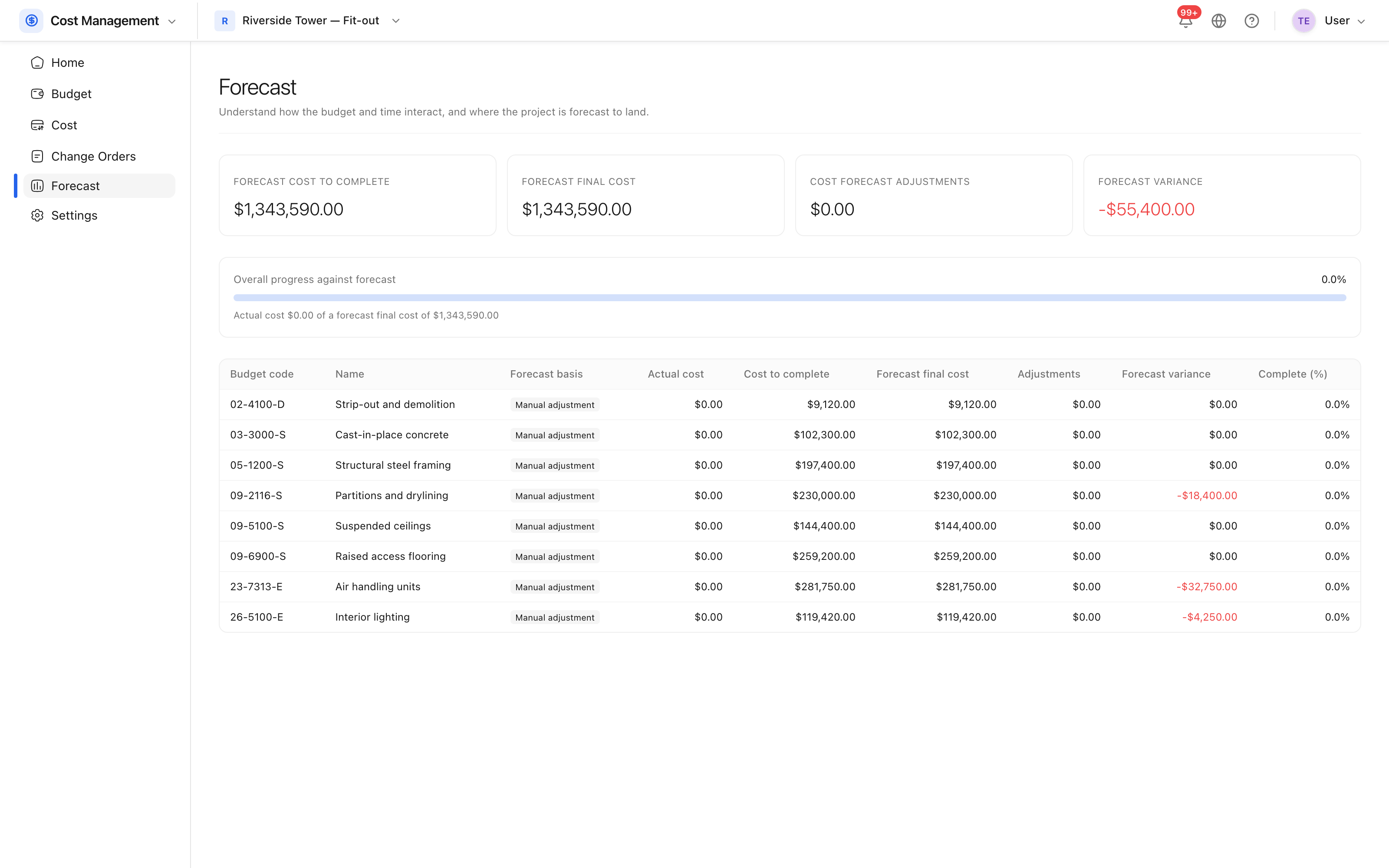 Each budget line with its forecast basis and its projected final cost.
Lines with no forecast are carried at their revised budget, which is a reasonable default and a bad assumption to leave in place on a line you know is overspending.
The three bases
| Basis | Enter | Suits |
|---|---|---|
| Manual adjustment | Cost to complete, or the final cost directly | Lines you have a view on |
| Output complete | Units forecast, units done, or percent complete | Measured work — square metres of partition |
| Date range | The window the resource is spread over | Time-related cost — preliminaries, plant hire |
Output complete is the honest one where the work is measurable: it derives the final cost from the rate the work is actually going at, rather than from somebody's optimism.
What happens to the variance
Where the forecast differs from the revised budget, the difference can either be saved as a variance — reported, and left to be explained — or turned into an adjustment, which generates a potential change order for the difference.
Save it as a variance while you are still working out whose it is. Turn it into a PCO once you know, so that it enters the change process rather than sitting in a spreadsheet.